
KS3 Foundational Knowledge Progression Framework (Geography)
What does it mean to get better at geography?

Purpose
This framework sets out what progression in foundational geographical knowledge looks like across Key Stage 3 and is a follow up to this post exploring some of the ideas
This framework moves beyond viewing knowledge as the accumulation of disconnected facts and instead defines progression as increasing access to the concepts, representations and disciplinary structures that underpin geographical thinking.
It is grounded in the understanding that:
knowledge is both substantive and disciplinary,
conceptual understanding organises factual knowledge,
and foundational knowledge enables pupils to participate meaningfully in geographical enquiry and application.
Underlying principles
1. Foundational knowledge is enabling knowledge
Foundational knowledge is not simply introductory content.
It provides the structures through which pupils interpret new information and think geographically.
2. Progression involves increasing conceptual coherence
Progression occurs when pupils:
connect knowledge,
recognise patterns,
understand relationships,
and use concepts across contexts.
3. Place knowledge matters
Secure knowledge of places provides the context through which geographical concepts become meaningful.
Progression is not moving away from place knowledge but using it with increasing sophistication.
4. Disciplinary knowledge and substantive knowledge are inseparable
Pupils need to understand both:
geographical content,
and how geographical knowledge is constructed, represented and evaluated.
Structure of the framework
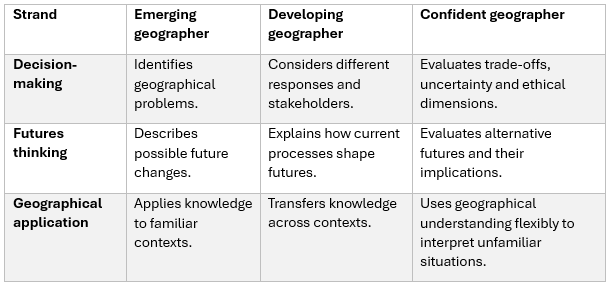
The framework is organised into four components:
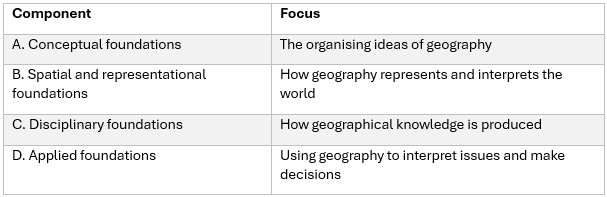
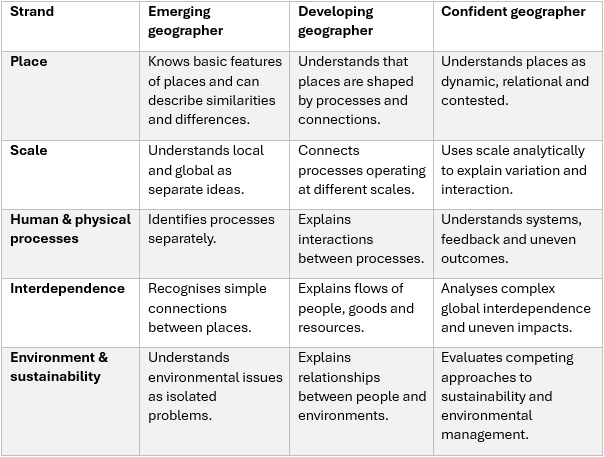
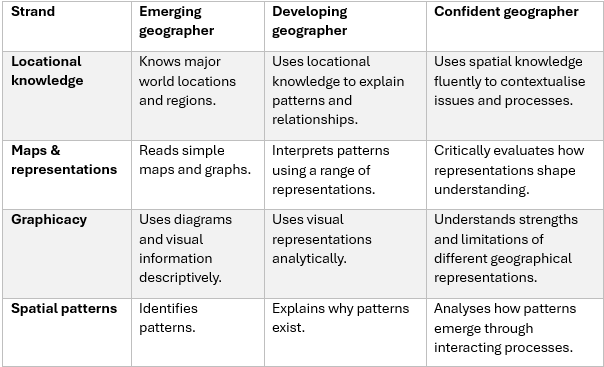
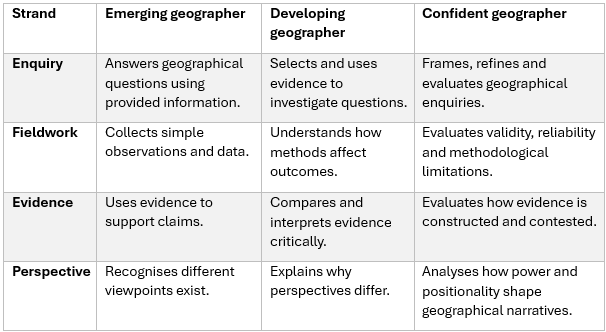
Each strand progresses from:
Emerging geographer
Developing geographer
Confident geographer
A. Conceptual foundations
B. Spatial and representational foundations
C. Disciplinary foundations
D. Applied foundations
What progression looks like
For example, in a unit on urbanisation:
Emerging
Pupils know:
cities are growing,
migration increases urban populations,
some cities experience problems such as congestion or pollution.
Developing
Pupils understand:
urban growth is linked to economic development,
urbanisation varies between countries,
migration, planning and inequality interact.
Confident
Pupils understand:
urbanisation as part of wider global systems,
how urban change operates differently across scales,
how political, economic and environmental priorities shape urban futures,
and why different groups experience urbanisation differently.
The topic remains similar but the conceptual control becomes more sophisticated.
Why this framework matters
One of the strengths of this approach is that it avoids the false dichotomy between:
knowledge,
and skills.
Much of what is often described as “geographical skill” is actually:
the application of foundational disciplinary knowledge.
For example:
interpreting a choropleth map depends on representational knowledge,
evaluating a flood management strategy depends on conceptual knowledge,
fieldwork depends on procedural knowledge.
This gives a much richer account of progression than:
“can describe”,
“can explain”,
“can evaluate”.