
Beyond Blooms
A framework for progression in geographical writing

Why a return to Bloom’s is not the answer to progression in writing
Every so often, something familiar returns to schools, presented as a solution to a problem that has never quite gone away.
Recently, I have noticed a renewed interest in using Bloom’s taxonomy to structure progression in writing. The logic behind this is easy to understand. If we can move pupils from describing, to explaining, to evaluating, then surely their writing must be improving. It gives a sense of order, a visible ladder of progression, and a shared language that appears to travel easily across subjects.
The difficulty is that this is not how disciplines work.
And if we are serious about building a knowledge-rich curriculum, it is not how writing improves either.
The problem with generic models of progression
Bloom’s taxonomy was never designed to describe how pupils get better at writing in specific subjects. It offers a general model of cognitive processes, not a subject-specific account of what it means to think, argue or explain within a discipline.
When it is applied to writing, it often produces a familiar pattern. Year 7 pupils are expected to describe. By Year 8 they explain. By Year 9 they evaluate. On paper, this looks like neat progression. In practice, it can be quite misleading.
One issue is that it creates a hierarchy of tasks that does not hold up under scrutiny. Description is treated as inherently simple, while evaluation is positioned as more complex. Yet in geography, a precise description of a spatial pattern, grounded in secure knowledge and careful observation, can demand far more disciplinary thinking than a superficial attempt to evaluate a strategy. The verb tells us very little about the quality of thought that sits behind it.
A second issue is that it detaches writing from the discipline itself. Pupils are asked to evaluate, but evaluate what, using what knowledge, and according to which conceptual frameworks? Without clear answers to those questions, writing becomes generic. It begins to look the same across subjects, and in doing so, loses the distinctive ways of thinking that give each subject its value.
A knowledge-rich curriculum demands something different
If we take seriously the idea of a knowledge-rich curriculum, then progression in writing has to be rooted in the discipline. Writing is not a generic skill that can be layered on top of content. It is the means through which disciplinary thinking is expressed.
In geography, this means recognising that good writing is the outcome of thinking geographically. It reflects how pupils understand place, space and environment; how they explain processes and patterns; how they use evidence; and how they engage with questions about the world.
The Geographical Association Curriculum Framework makes this point clearly. It describes geography as a discipline made up of three interrelated components: geographical concepts, geographical practice and geographical application. These are not separate strands that can be taught in isolation. They are mutually reinforcing, and together they define what it means to think and work like a geographer.
If that is the case, then progression in writing should not be organised around generic verbs. It should be understood as increasing control over these aspects of the discipline.
What progression actually looks like
Once we start from the discipline, the nature of progression becomes clearer. It is less about moving between different types of task and more about the growing sophistication with which pupils use knowledge and ideas.
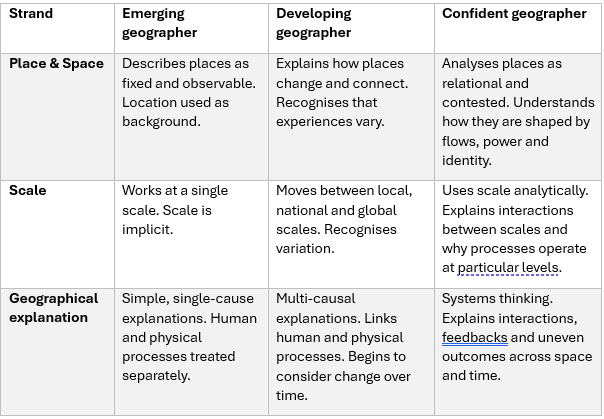
Take explanation as an example. A pupil at an early stage might identify a single cause for an event. With more knowledge and experience, they begin to link causes together, showing how one factor leads to another. Over time, they start to recognise that processes interact, that physical and human factors are connected, and that outcomes vary between places. At a more advanced level, explanation begins to take on a systems character, incorporating ideas such as feedback, thresholds and change over time.
At no point in this process is the key shift captured simply by moving from “explain” to “evaluate”. The verb remains the same. What changes is the quality and structure of the thinking.
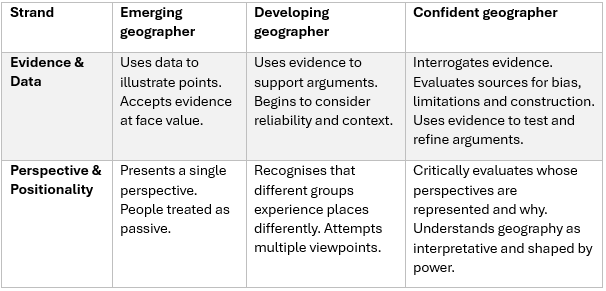
A similar pattern can be seen in how pupils use evidence. Early writing often includes data as a way of illustrating a point, with little consideration of where that data comes from or how it has been produced. As pupils develop, they begin to select evidence more carefully and use it to support their reasoning. With further progression, they start to question the evidence itself, considering its reliability, its limitations and the perspectives it represents. At this point, writing moves beyond using evidence to confirm ideas and begins to use evidence to test and refine them.
This is progression, but it is not captured by a hierarchy of command words.
Building a disciplinary framework for writing
Working from these ideas, it becomes possible to construct a framework for progression in geographical writing that is rooted in the discipline rather than in generic models.
At its core, such a framework can be organised around three components.
The first is thinking like a geographer. This includes how pupils understand place and space, how they use the idea of scale, and how they construct explanations. Early writing often treats places as fixed and bounded, described in terms of their observable features. As pupils develop, they begin to see places as dynamic and connected, shaped by flows of people, goods and ideas. Stronger writing recognises that places are relational and contested, and that different groups may experience the same place in very different ways.
The second component is working like a geographer. This is concerned with how pupils use evidence and how they handle perspective. Progression here involves moving from using data at face value, to selecting and deploying evidence with purpose, and eventually to interrogating that evidence critically. It also involves recognising that geographical accounts are not neutral. They are shaped by viewpoints, values and power, and understanding this is a key part of disciplinary thinking.
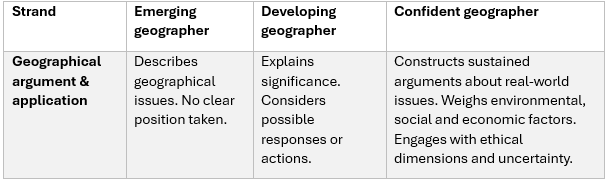
The third component is using geography. This is where writing moves beyond explanation into application. Pupils begin by describing geographical issues, but over time they start to consider their significance and implications. More advanced writing constructs sustained arguments about real-world challenges, weighing different factors and recognising that decisions often involve trade-offs and uncertainty.
Taken together, these components provide a much richer account of progression than a simple movement through command words. They keep writing anchored in the discipline, where it belongs.
Why this matters
The shift here is subtle but important. It moves us away from asking whether pupils have used a particular type of response, and towards asking how well they are thinking within the subject.
Instead of asking, “Have they evaluated?”, we begin to ask more meaningful questions. Are they using knowledge precisely and appropriately? Are they able to build causal explanations that go beyond single factors? Can they think across different scales and recognise how processes vary between places? Do they understand that different perspectives exist, and that these matter? Are they able to construct a reasoned argument about a geographical issue?
These questions are more demanding, both for pupils and for teachers. They are harder to reduce to a simple rubric or checklist. But they are also much closer to what it means to learn geography well.
The risk of getting this wrong
There is always a temptation to simplify progression so that it becomes easier to plan, teach and assess. The danger is that in doing so, we strip away the very features that make subjects distinctive.
Geography risks becoming a sequence of tasks: describe a case study, explain a process, evaluate a strategy. This is manageable, but it is also limiting. It can lead to a curriculum that feels fragmented, with little sense of how knowledge connects or builds over time.
A disciplinary approach offers something different. It foregrounds the big ideas of the subject, the ways in which knowledge is constructed, and the relevance of geography to understanding the world. It asks more of pupils, but it also gives them more in return.
A better way forward
If we want pupils to write well in geography, then the starting point has to be the curriculum itself. Pupils need secure knowledge of places, processes and concepts. They need to encounter these ideas repeatedly, in different contexts, so that their understanding deepens over time.
Alongside this, they need to be taught explicitly how geographers think and work. This includes modelling how to build explanations, how to use evidence, and how to consider different perspectives. Writing should be used as a way of making this thinking visible, not as a bolt-on at the end of a lesson.
When these elements are in place, progression in writing follows naturally. It is not driven by a sequence of command words, but by the gradual development of disciplinary understanding.
Final thought
Bloom’s taxonomy is not without value. It offers a useful way of thinking about different kinds of cognitive demand. But it was never intended to serve as a model for subject-specific progression, and it is not well suited to that purpose.
A knowledge-rich curriculum asks us to go further. It requires us to think carefully about what it means to know, to think and to write within a discipline. In geography, that means helping pupils to understand the world as a set of interconnected systems, shaped by processes, perspectives and power.
Writing, at its best, is where that understanding becomes visible.